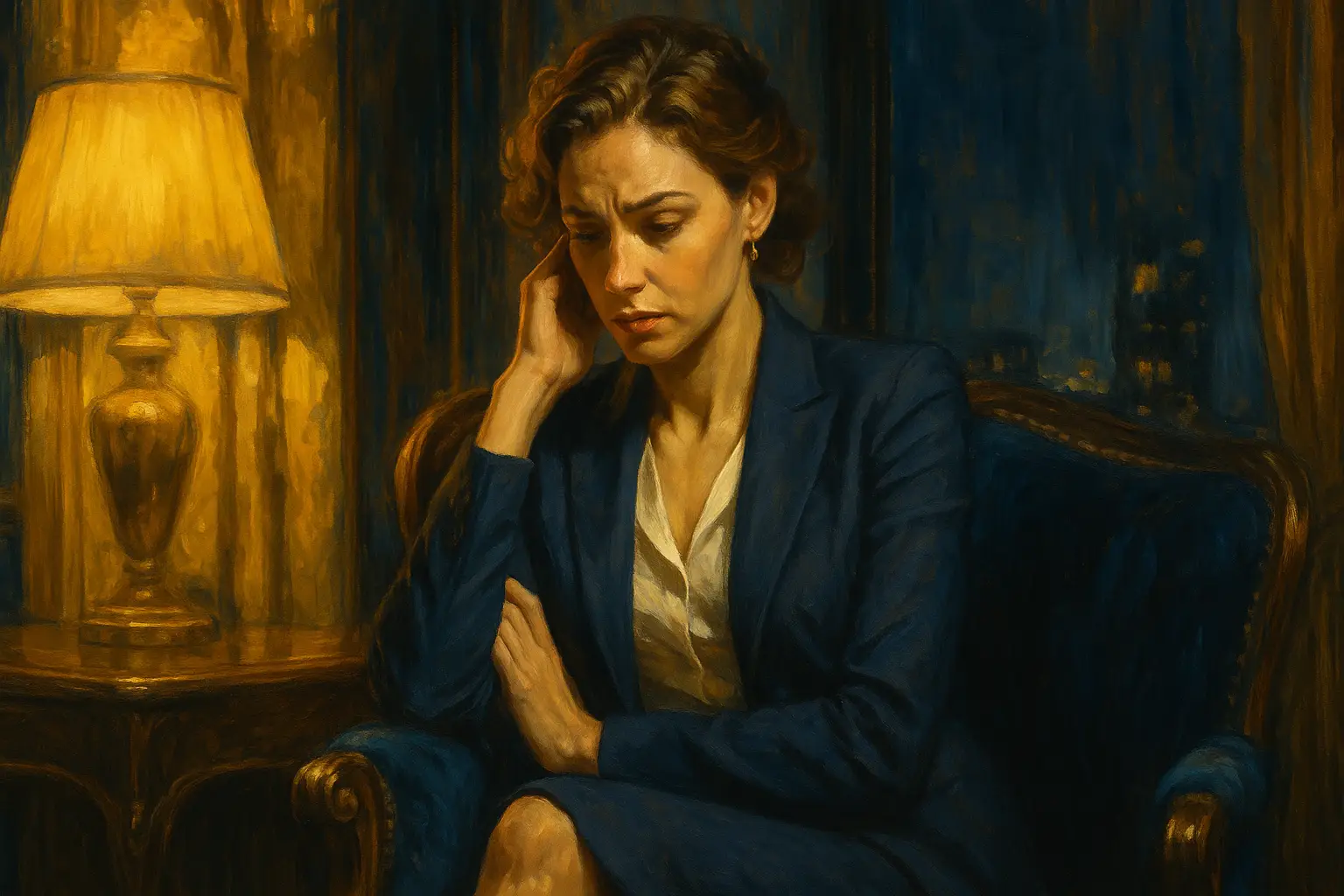
You finished cognitive behavioral therapy for panic attacks. The attacks eased. You still map the exits in every room. That is not failure and not a relapse. CBT reaches the attack; it was never built to locate the pattern underneath the anticipation. This is what remains, and what it takes to reach it.
The sentence people say when the attacks have already stopped
“I usually plan my exit before planning my entrance.”
Someone wrote that on an intake form before we’d ever spoken. The question hadn’t asked about exits. It asked about triggers.
Out loud, in a session, it comes out longer:
“Everywhere I go I try to figure out an escape plan. I keep myself near the exit. It’s exhausting.”
Some version of that gets said here more than almost anything else. Almost never by someone in the middle of an attack.
It gets said by people who aren’t having many attacks anymore.
They’ve done cognitive behavioral therapy for panic attacks. A full course. Weekly, for months. They can name the loop. They know the sensation won’t kill them. When one comes they ride it out, and it’s shorter than it used to be.
By any clinical measure, they’re better.
They still map the exits.
Nobody explained that to them. So they drew the obvious conclusion — after all that work, something must still be wrong with them specifically.
Something is running. It isn’t what they think.
Two different things wearing the same name
A panic attack and the fear of a panic attack are not the same event. Different length, different feel, different origin. One word covers both, and that causes a lot of unnecessary suffering.
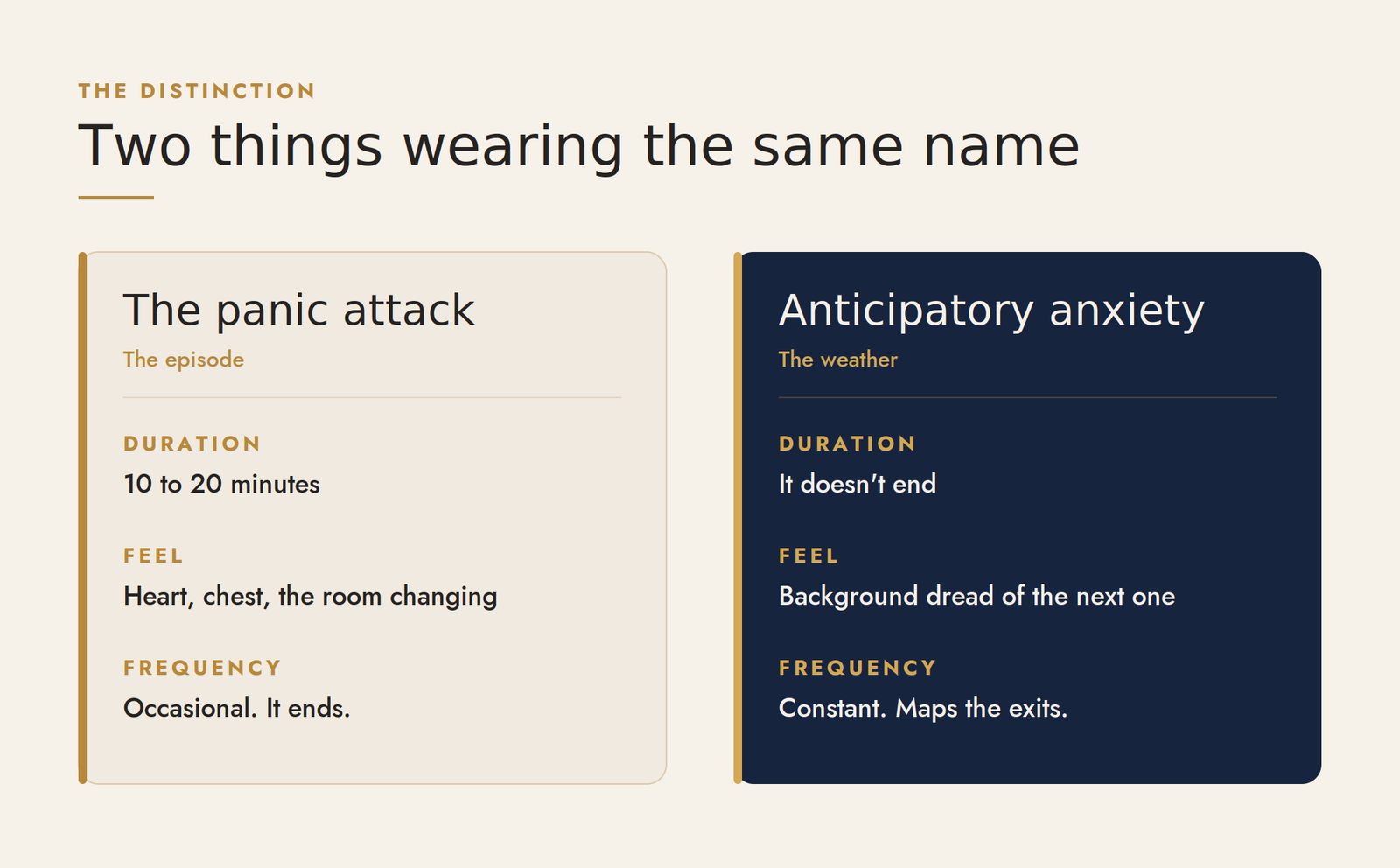
The attack is short. Ten minutes, maybe twenty. Heart, chest, the room changing.
What comes after doesn’t end.
Once you’ve had one, there’s a background anxiety about if and when it happens again. Out with friends. At a party. Travelling. At work.
That background is what reorganizes a life. It keeps you near the door. It’s why you know where the bathrooms are in a restaurant you’ve never been to. It’s why the aisle seat matters more than it should.
None of that is the panic attack. All of it is the anticipation of one.
Clinically it’s called anticipatory anxiety. For most people it isn’t a footnote to panic disorder. It is the disorder. The attacks are episodes. This is the weather.
Chest pain, breathlessness, a pounding heart — get them looked at. Cardiac conditions, thyroid problems and arrhythmias present the same way. Do the rule-out first. Then the question of pattern is a real question instead of a guess.
What cognitive behavioral therapy for panic attacks is built to do
CBT for panic disorder is one of the better-built things in clinical psychology. It deserves an accurate description, not a caricature.
The model: a sensation gets read as catastrophic, the reading produces more sensation, the loop closes. That’s precise, and it treats people. The active ingredient is exposure — interoceptive exposure specifically. You provoke the sensations you’re afraid of, on purpose, until the prediction attached to them stops holding. Spin in a chair. Breathe through a straw. Let your heart race and let nothing happen.
It works. That’s not a small thing.
Two things complicate it. Both come from inside the field.
The response rates are lower than the reputation. Loerinc and colleagues reviewed CBT outcomes across the anxiety disorders in Clinical Psychology Review. Response averaged 49.5% at the end of treatment and 53.6% at follow-up. Roughly half. Michelle Craske, who built much of modern exposure theory, is the senior author. This is the field checking its own work.
And plenty of people who did “CBT” never got the active ingredient. Deacon, Lickel, Farrell, Kemp and Hipol looked at how therapists actually deliver interoceptive exposure for panic disorder. Clinicians with stronger reservations about intense, prolonged interoceptive exposure were more likely to hand their clients controlled breathing instead.
The therapist, uneasy about the part that does the work, substitutes a breathing technique.
Hipol and Deacon also found exposure being used at roughly the rate of interventions with no evidence behind them at all, and self-directed exposure used about three times as often as therapist-assisted exposure. That survey covered practitioners in one state. Narrow, but it points somewhere.
So when someone says CBT didn’t completely resolve it, there are a few honest possibilities. They had the conversation without the exposure. They’re in the half the numbers describe. Or the exposure reached the attack and never reached what sits under it.
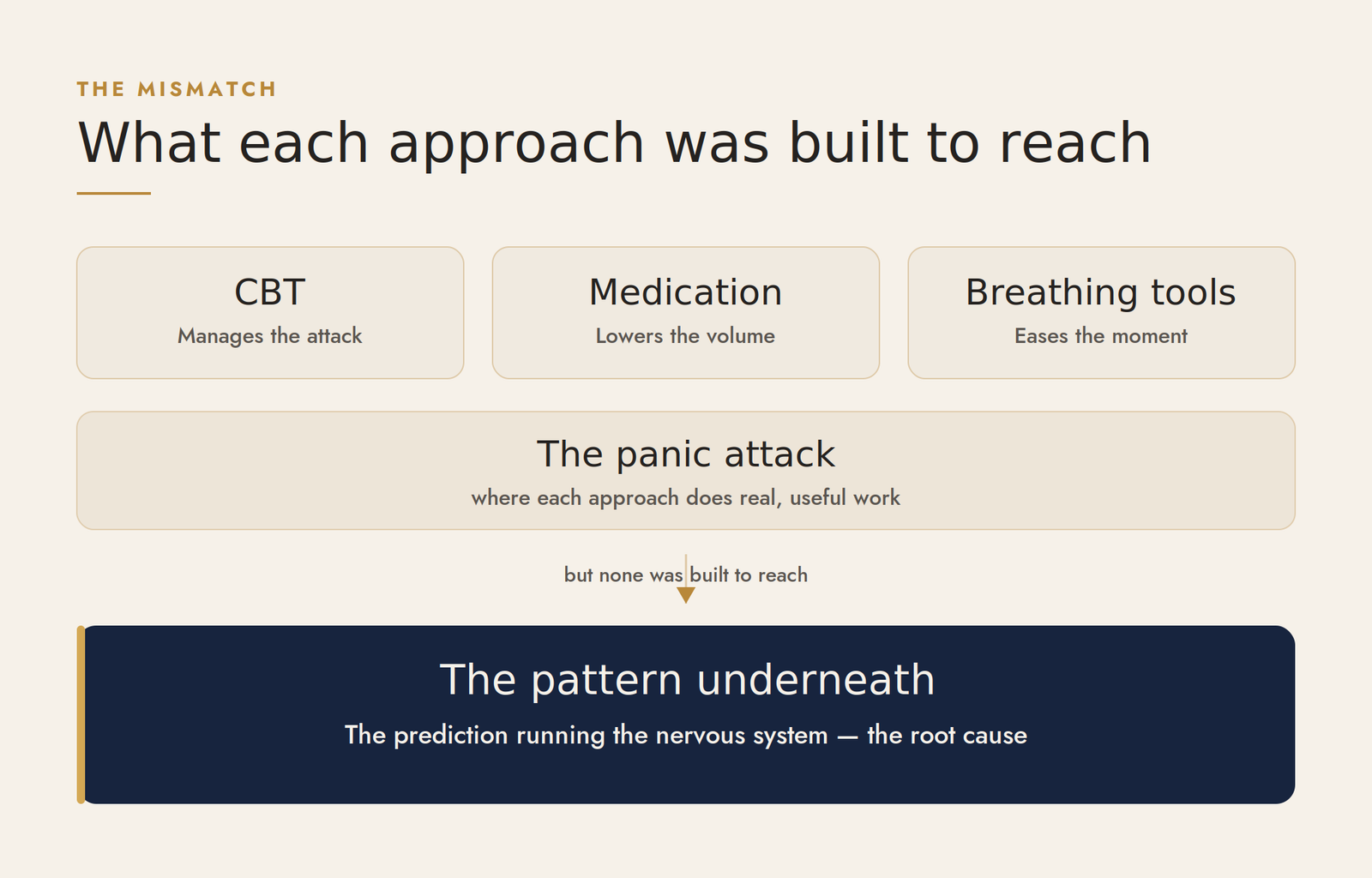
Medication runs the same shape. SSRIs cut the frequency and force of attacks for a lot of people. They were never designed to find why this nervous system, this year. Breathing apps do something real in the moment and nothing to the pattern. Avoidance works — it’s the most effective panic management there is, and the price is your life getting smaller.
All of it does something. None of it was built to find what’s running it.
Your body left before you did
Here’s the part almost nobody who has finished cognitive behavioral therapy for panic attacks has been told.
Meuret, Rosenfield, Wilhelm and colleagues put ambulatory monitors on forty-three people with panic disorder and recorded them around the clock. Across 1,960 hours they caught thirteen real panic attacks. Not provoked in a lab. In life.
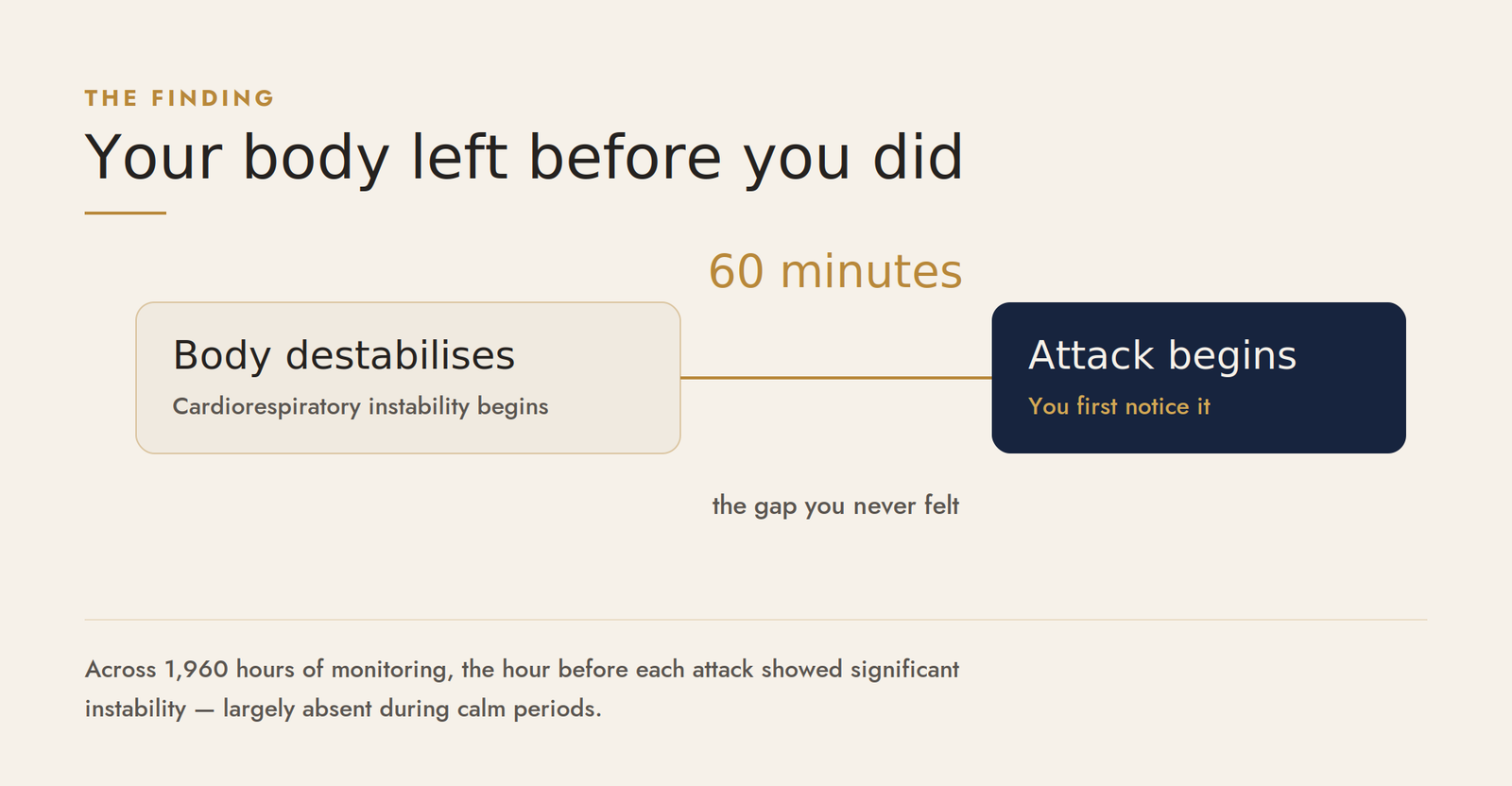
The hour before each one showed significant cardiorespiratory instability. Waves of it. Changes in breathing and heart rate that were mostly absent during control periods. The same monitoring showed these people were chronically hyperventilating without knowing it.
Sixty minutes. The body had already left before the person noticed anything.
That matters because of what people get told. “Out of the blue” gets explained as: you had a thought and you missed it. Catch it earlier next time. Which quietly puts it on you. The attack happened because your attention failed.
The physiology says otherwise. You’re not too slow to catch a thought. You’re carrying a running bodily state you were trained, for decades, not to feel.
The attack isn’t the moment the state begins. It’s the moment it crosses into consciousness.
So the escape plan makes sense. The nervous system isn’t being irrational when it keeps you near the door. It’s acting on a prediction, and the prediction is running on old data.
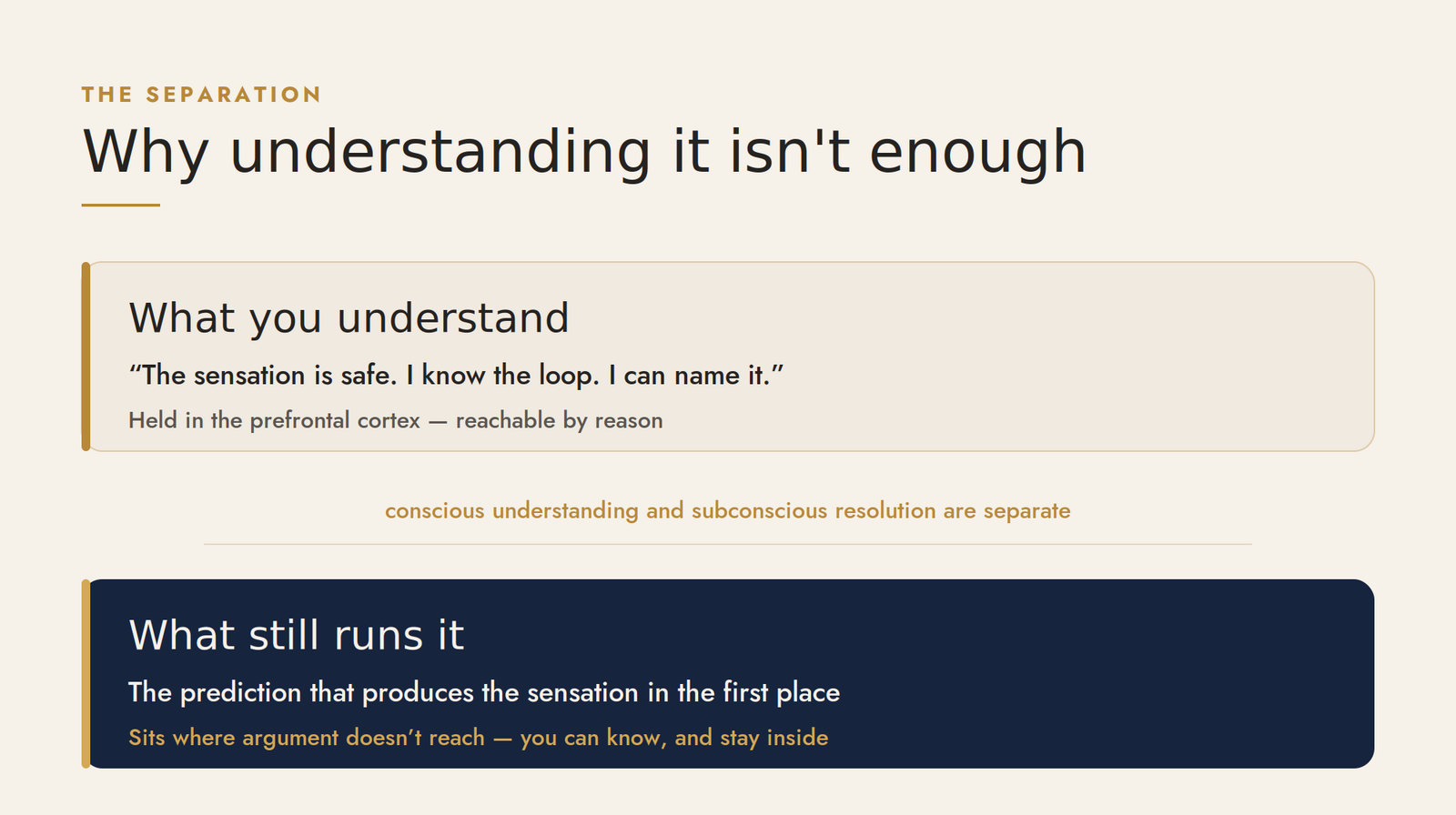
This is where conscious understanding and subconscious resolution come apart, and almost every approach blurs it. Knowing a sensation is safe is a fact you hold in the prefrontal cortex. The prediction that produces the sensation sits somewhere argument doesn’t reach. You can understand a pattern completely and still be inside it. Most people who arrive here are proof of that.
Three lines of research say the same thing from different angles. Bruce Ecker’s work on memory reconsolidation: an emotional learning gets rewritten, rather than suppressed, when it’s reactivated and then contradicted by experience — not by a counter-statement. Lisa Feldman Barrett’s predictive processing: panic is a stored prediction, running on the body, ahead of awareness. David Spiegel’s group at Stanford, on what hypnosis does to the brain: the default mode network quiets, and connectivity rises between the executive control network and the salience network — the network that decides what counts as a threat.
What it looks like from the inside
It looks like planning the exit before planning the entrance. Finding the door before you find your friends.
Declining dinner at a restaurant with one way out. Booking the flight with a stopover so no leg runs too long. Sitting in a meeting, completely present, completely competent, running a background calculation about how you’d leave if you had to.
It looks like the work going fine. The career intact. Nobody noticing.
And it looks like the exhaustion of it, which nobody sees, because the whole thing was built to be invisible. That’s the part people say last, near the end of a first conversation, usually quieter.
None of it is weakness. It’s a very predictable response to something running undetected, managed by someone highly capable. The people who come to this work are, almost without exception, the most high-functioning people in the room. Not a coincidence. The same capacity that built the career built the escape plan.
What’s possible when the pattern is located instead of managed
Panic attack treatment that stops at the attack has a ceiling built into it. Manage the episode well and the anticipation continues, because the anticipation was never the target.
The answer isn’t a better management technique. It’s finding what’s producing the prediction, and updating it.
That’s what the Freedom from Panic Method does. It uses Advanced Conversational Hypnotherapy — Ericksonian work — to reach the specific learning that taught this nervous system this response, and to meet it with an experience that contradicts it rather than an argument that disagrees with it.
That’s the difference between managing a pattern and dissolving one.
What changes isn’t that you get better at exits.
You walk into a room and the exit is a door.
Questions people ask before they book
Does cognitive behavioral therapy work for panic attacks?
For many people, yes. Across the anxiety disorders, response to CBT averaged 49.5% at the end of treatment and 53.6% at follow-up. Its active ingredient is interoceptive exposure. CBT does what it was built to do. It does not reach everyone, and it was not designed to locate the pattern producing the panic in the first place.
Why do panic attacks come back after therapy?
There are a few honest possibilities. Some people received the cognitive conversation without the exposure that does most of the work. Some fall in the roughly half the outcome data describes. And in many cases the treatment reached the attack but never reached the anticipatory anxiety underneath it.
Do panic attacks really come out of nowhere?
No. Meuret and colleagues captured thirteen naturally occurring attacks across 1,960 hours of monitoring. The hour before each showed significant cardiorespiratory instability, largely absent during calm periods. The body destabilises roughly sixty minutes before awareness.
What is the difference between a panic attack and anticipatory anxiety?
A panic attack is acute and brief, ten to twenty minutes. Anticipatory anxiety is the ongoing background worry about whether and when the next one comes. For most people with panic disorder, the anticipation reorganises daily life far more than the attacks do.
Can hypnotherapy help with panic attacks?
Advanced Conversational Hypnotherapy works at the level of the prediction producing the panic rather than managing the attack. No approach guarantees an outcome before the specific pattern is located.
Should I see a doctor about these symptoms?
Yes. Chest pain, breathlessness and a pounding heart deserve a medical assessment. Cardiac conditions, thyroid dysfunction and arrhythmias can present the same way. Complete the medical rule-out first.
The escape plan is specific to you. So is what’s underneath it.
The Panic Reset Session is a complimentary 45-minute conversation — a look at your particular pattern, and an honest read on whether this work would reach it. The next morning you get your Panic Pattern Insight Report: what was located, in writing.
Book a Panic Reset Session
Angelo Dela Cruz
Founder of The Higher-Powered Life. He works with high-functioning professionals to locate and resolve the root pattern beneath panic — not to manage the symptom.
References
- Loerinc, A. G., Meuret, A. E., Twohig, M. P., Rosenfield, D., Bluett, E. J., & Craske, M. G. (2015). Response rates for CBT for anxiety disorders. Clinical Psychology Review, 42, 72–82.
- Meuret, A. E., Rosenfield, D., Wilhelm, F. H., et al. (2011). Do unexpected panic attacks occur spontaneously? Biological Psychiatry, 70(10), 985–991.
- Deacon, B. J., Lickel, J. J., Farrell, N. R., Kemp, J. J., & Hipol, L. J. (2013). Therapist perceptions and delivery of interoceptive exposure for panic disorder. Journal of Anxiety Disorders, 27(2), 259–264.
- Hipol, L. J., & Deacon, B. J. (2013). Dissemination of evidence-based practices for anxiety disorders in Wyoming. Behavior Modification, 37(2), 170–188.
- Ecker, B. (2012). Unlocking the Emotional Brain.
- Barrett, L. F. (2017). How Emotions Are Made.